
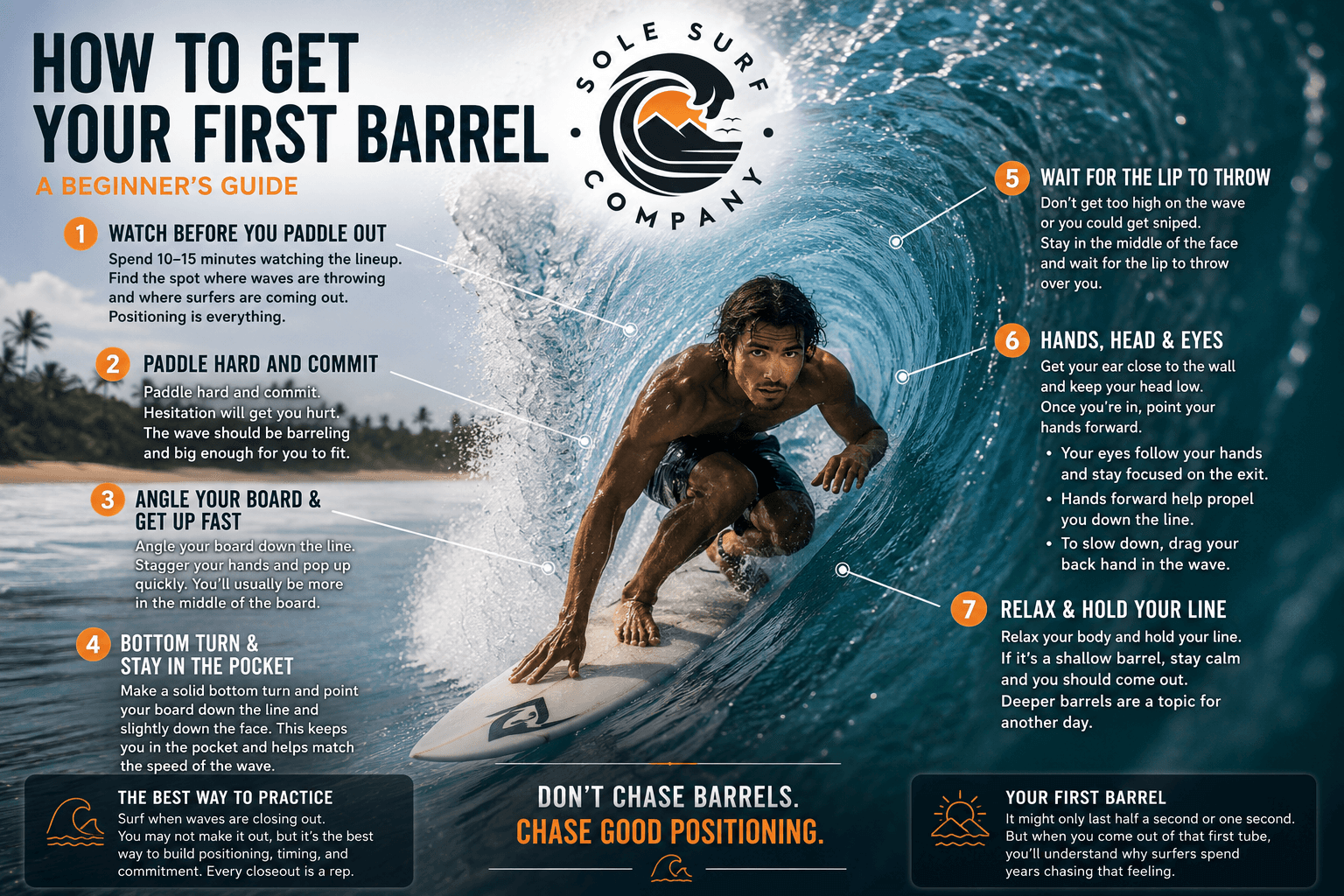
How to Get Your First Barrel
There's something special about getting your first barrel. It usually isn't a long, deep tube that lasts several seconds. More often than not, it's only half a second—maybe a full second—before you're back in the sunlight. But I promise you this: you'll remember it for the rest of your life.
Once you're comfortable paddling out, catching waves, riding left and right, and making basic turns, the next natural step in your surfing progression is learning floaters and barrels. In my opinion, there's nothing more satisfying than finally hearing the wave throw over your head and realizing you're actually inside one.
This isn't the only way to get barreled, and I'm certainly not claiming to have all the answers. It's simply what I've learned over the years through a lot of trial, error, and plenty of wipeouts.
1. Watch Before You Paddle Out
Before you ever paddle for a wave, spend ten or fifteen minutes simply watching.
Every barreling wave has a section where it throws, and every break has its own rhythm. Watch where surfers are getting covered up, where they're getting clipped by the lip, and where they're successfully coming out. A few feet too deep or a few feet too wide can be the difference between the best wave of your life and getting pitched over the falls.
Positioning is everything. If you start in the wrong spot, even perfect technique probably won't save you.
It's also important to choose the right wave to learn on. You don't need a six-foot Pipeline-style barrel. A chest-high or slightly overhead wave that throws just enough to cover you is the perfect classroom. Remember, a one-second cover-up still counts as a barrel.
2. Paddle Hard and Commit
Once you've picked your wave, it's time to commit.
The biggest mistake I see is hesitation. The moment you decide you're going, paddle as hard as you can. Half-committing usually leaves you in the worst possible position—too late to make the section but too early to kick out. That's also when wipeouts become the most dangerous.
Of course, this assumes you've chosen the right wave. It should already be barreling and be large enough for you to physically fit inside it. It doesn't need to be a perfectly hollow, stand-up tube. Even a small cover-up is enough to teach you the fundamentals.
3. Angle Your Board and Get to Your Feet Quickly
As you're paddling, angle your board down the line instead of straight toward the beach. I also like to stagger my hands during the pop-up because it helps me get to my feet a little faster.
When you're chasing your first barrel, every fraction of a second matters. A quick, smooth pop-up gives you precious time to set your line before the lip throws over. You'll also find that you naturally end up standing a little more centered on your board than you would on a normal open-face wave, and that's perfectly okay.
4. Bottom Turn and Stay in the Pocket
Once you're on your feet, make a solid bottom turn and get yourself into the pocket.
One thing that really helped me understand barreling waves is realizing how quickly they draw water off the reef or sandbar. If your board stays too flat or points straight across the face, you'll often outrun the barrel or get sucked up the face and thrown over the falls.
Instead, point your board down the line with a slight downward angle. You're not trying to race the wave—you’re trying to match the speed of the pocket and stay where all the energy is.
5. Wait for the Lip to Throw
Patience becomes important here.
A common mistake is climbing too high on the wave before the barrel actually forms. If you do that, the lip can hit you directly on the head. Surfers call this getting "sniped."
Instead, stay around the middle of the wave face. Your board should be roughly halfway up the face, while your upper body naturally sits closer to the top of the wave. Hold that line and let the lip throw over you instead of trying to force your way underneath it.
Most of the time, good positioning does all the work.
6. Hands, Head, and Eyes
Once you're inside the barrel, your body position becomes incredibly important.
I like to keep my ear close to the wave face, stay compact, and point both my front and back hands toward the exit.
There are two reasons I do this.
First, your eyes naturally follow your hands. If your hands are pointing toward daylight, your body will usually follow. Never stare at the lip that's throwing over you. Instead, keep looking where you want to go—the opening at the end of the barrel.
Second, reaching your hands forward naturally carries your weight down the line and helps maintain momentum.
If you find yourself getting ahead of the wave, lightly drag your trailing hand through the face. The goal isn't to go as fast as possible. The goal is to match the speed of the barrel. Sometimes that means generating speed, and sometimes it means slowing yourself down just enough to stay in the pocket.
7. Relax
This might be the hardest part.
The moment the wave throws over your head, your natural instinct is to tense up. Try not to.
Keep your knees bent, your shoulders relaxed, and your eyes fixed on the exit. Trust the line you've already set and let the wave do the work.
Most first barrels are fairly shallow. If you've positioned yourself well, there's a good chance you'll simply glide out the other side. Deep barrels require a few more tricks, but that's a conversation for another article.
The Best Way to Practice
Ironically, one of the best places to practice barrels is on closeout waves.
You probably won't make it out.
And that's perfectly fine.
Those waves teach you timing, positioning, commitment, and what it actually feels like when the lip throws over your head. Every failed attempt builds muscle memory. Then, when the day finally comes that a wave offers you an exit, your body already knows what to do.
Think of every closeout as another repetition. Those reps add up faster than you think.
One Last Thought
Don't chase barrels.
Chase good positioning.
Many beginners think getting barreled is mostly luck. It's not. Luck plays a role, but consistently getting barreled comes from putting yourself in the exact spot where the wave wants to throw. If you can learn to do that over and over again, eventually the ocean will reward you.
Your first barrel probably won't be deep.
It probably won't last very long.
It might only last half a second.
But when you come flying out of that first tube, you'll finally understand why surfers spend years chasing that feeling.
You'll remember your first barrel for the rest of your life.
Daniel Sole
Founder, Sole Surf Company
Image Note: The featured image was generated using AI.

Hinterlasse einen Kommentar
Diese Website ist durch hCaptcha geschützt und es gelten die allgemeinen Geschäftsbedingungen und Datenschutzbestimmungen von hCaptcha.