
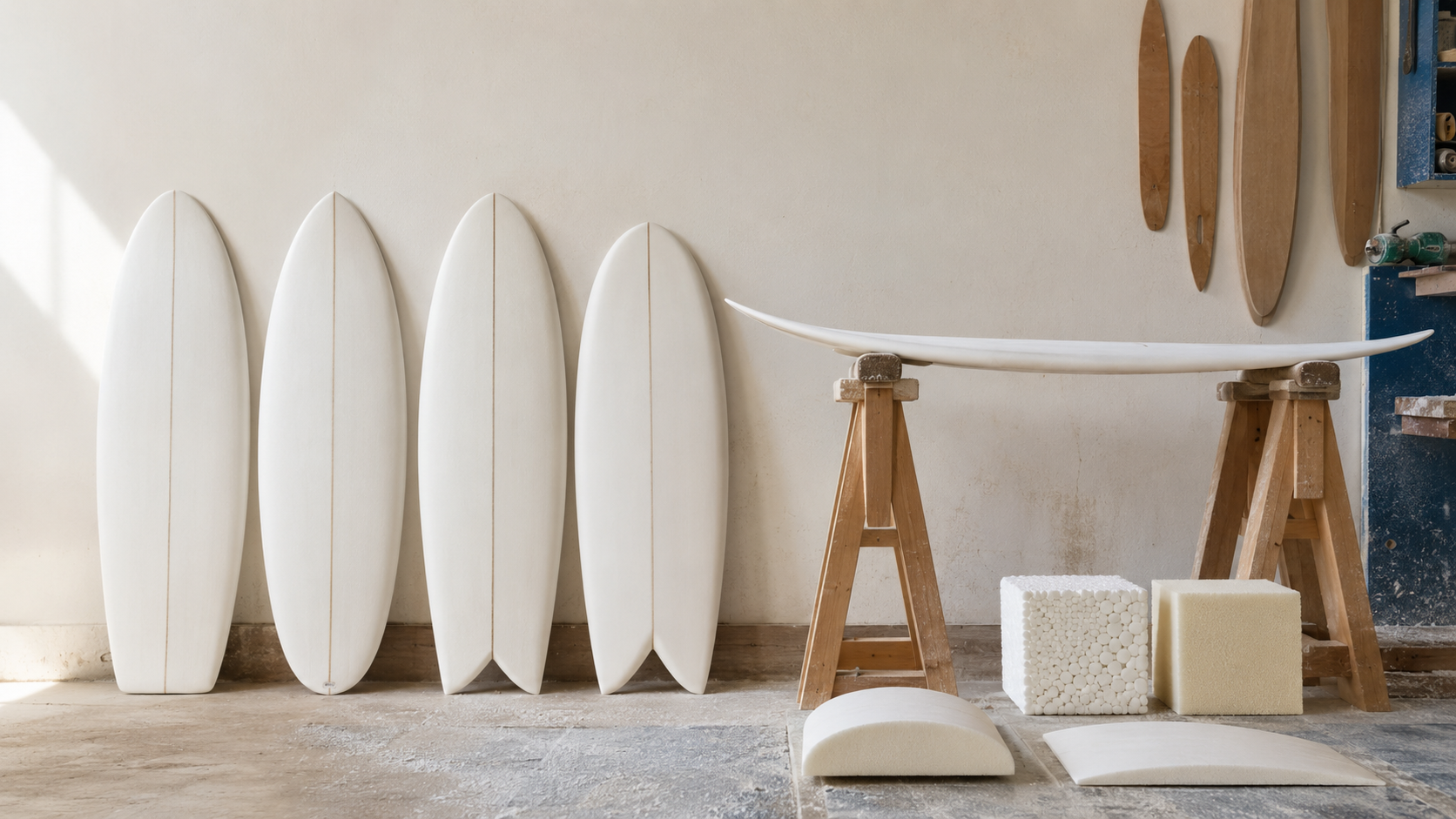
Surfboard Design 101: Tails, Rails, Rocker, Concave and Foam Explained Part 1
Surfboards may look simple from the outside, but small differences in their design can completely change how they paddle, generate speed and turn. Tail shape, rocker, bottom contours, rails and construction all influence the way a board feels beneath your feet.
These features do not work independently. A fast tail can be balanced by additional rocker, while concave can restore lift and speed to a board designed with more curve. Two boards with the same tail shape can therefore feel completely different if one has a wider outline, flatter rocker or fuller rails. Understanding how these elements work together will help you choose a board that matches your ability, surfing style and typical waves.
Surfboard Tail Shapes
A surfboard’s tail influences its speed, hold, turning radius and release. Tail width and the overall outline are often more important than the final shape at the very end of the board, but each tail shape still has recognizable characteristics.
Round/Thumb Tails
Round or thumb tails have a smooth, continuous curve without sharp corners. This allows water to flow around the tail smoothly and keeps the rail engaged throughout a turn.
These tails produce controlled, flowing turns and smooth transitions from one rail to the other. They are commonly used for top-to-bottom surfing and perform particularly well in clean waves with some power.
A wider thumb tail carries more speed and generally feels more forgiving than a narrower round pin.
Turning summary: Smooth, flowing and controlled.
Pin Tails
A pin has a narrower outline and less surface area than a thumb tail. This allows the tail to sit deeper in the water, providing additional hold and control at higher speeds.
Pins produce powerful, drawn-out turns and hold well on steep wave faces. They are commonly associated with big-wave boards and step-ups because their narrower tails remain controlled when the waves become faster and more powerful.
The tradeoff is that a narrow pin usually needs more wave power and surfer input. It may feel slower or less responsive in weak surf.
Turning summary: Controlled, powerful and drawn out.
Squash Tails
The squash tail is one of the most versatile and widely used tail shapes. Its relatively wide surface area creates lift, speed and drive, making it especially effective in small-to-medium waves.
Its defined corners also act as release points, allowing the board to pivot and redirect quickly. This makes a squash tail well suited for sharp bottom turns, quick snaps and responsive top turns.
As a general rule, straighter sections of a surfboard’s outline create more drive and down-the-line speed, while increased outline curve allows the board to turn through a tighter arc.
Turning summary: Quick, sharp and responsive.
Swallow Tails
A swallow tail combines the planing area and speed of a wider tail with some of the hold associated with a pin tail. It is often described as two small pin tails working together.
The wider outline helps the board generate speed, while the cutout reduces surface area at the very end of the board. When the surfer puts the board on rail, one of the points bites into the wave face and provides additional hold. The defined points also create a clean release, allowing the board to feel fast and loose without completely sacrificing control.
The depth and width of the swallow matter. A deeper swallow creates longer, more pronounced points and generally provides more bite. A shallow swallow behaves more like a squash tail while still offering a slightly cleaner release.
Turning summary: Fast and loose with added bite.
Tail shape is only one part of the design. A wide round tail may turn more easily than a narrow squash tail, so these descriptions should be treated as general tendencies rather than absolute rules. The next major influence is the curve running beneath the entire board: its rocker.
Surfboard Rocker
Rocker is the curve that runs along the bottom of a surfboard from nose to tail. It affects paddling, speed, turning and how well the board fits into the curve of a wave. The amount of rocker—and where a shaper places it—helps determine whether a board is designed to fly through weak sections or remain controlled in steep, powerful surf.
Flatter Rocker
A board with less rocker has a straighter bottom profile. This allows more of the board’s surface to plane across the water, helping it accelerate quickly, glide efficiently and maintain speed through weak sections.
Flatter-rockered boards are commonly used in small or softer waves where the surfer needs to generate speed. They also tend to paddle efficiently and enter waves earlier.
The tradeoff is that a flatter board generally draws longer turning arcs and can be harder to redirect vertically. In steep or hollow waves, its straighter bottom curve may also have more difficulty fitting into tight sections or making late drops.
Performance summary: Fast, efficient and drive-focused, with longer turning arcs.
Increased Rocker
A board with more rocker has a stronger curve from nose to tail. It does not plane as efficiently as a flatter board and will generally create more drag in weak surf.
The benefit is maneuverability and control. Increased rocker allows the board to fit more naturally into a steep wave face and turn through a tighter arc. It can help the surfer redirect vertically and remain controlled in powerful or hollow conditions.
More rocker does not necessarily make a board loose. It allows the board to fit into tighter turns, but it can also provide additional control in critical sections.
Performance summary: Maneuverable and controlled, with tighter turning arcs.
Nose Rocker
Nose rocker is the curve through the front section of the board. More nose rocker helps prevent the nose from catching or pearling during steep or late drops. It is commonly found in boards designed for hollow or powerful waves.
The tradeoff is reduced paddling efficiency. A flatter entry rocker generally paddles faster, enters waves earlier and accelerates more quickly.
Some good-wave and big-wave boards combine a relatively low entry rocker with more tail rocker. This provides the paddle speed needed to catch the wave while maintaining control once the surfer is standing.
Performance summary: More nose rocker helps with steep drops; less nose rocker improves paddling and acceleration.
Tail Rocker
Tail rocker is the curve through the back portion of the board. More tail rocker allows the board to turn through a tighter arc and fit into a steeper section of the wave.
It can improve maneuverability, sensitivity and release during bottom turns and top turns. The tradeoff is generally less glide and reduced down-the-line speed in weaker waves.
Less tail rocker creates more drive and speed but usually produces longer turns and requires more effort to redirect.
Performance summary: More tail rocker creates tighter turns and control; less tail rocker creates speed and drive.
Rocker establishes the board’s lengthwise curve, but it is only part of the bottom design. Shapers also carve contours across that curve to control how water moves underneath the board.
Bottom Contours
Bottom contours determine how water enters, travels underneath and exits a surfboard. Single concave, double concave and vee can create lift and speed, improve rail-to-rail transitions or add control. Their effect depends on how deeply they are shaped, where they are placed and how they interact with the rocker.
Single Concave
A single concave is one continuous channel running along the center of the board. It directs water through the middle of the board and creates lift underneath the surfer’s feet.
This lift helps the board rise onto a plane, accelerate and maintain speed. Single concaves are particularly useful in smaller or weaker waves, but they are also used in many high-performance boards designed for good waves.
Deeper single concaves can create more lift and a powerful, fast feeling, but more depth is not always better. Too much concave can make a board feel overly lifted, tracky or difficult to roll from one rail to the other.
Performance summary: Lift, acceleration and strong down-the-line speed.
Double Concave
A double concave divides the water flow into two channels, usually through the back half of the board and between the fins.
Shapers commonly transition from a single concave under the front foot into a double concave near the fins. The single provides lift and speed, while the double helps the board transition more naturally from rail to rail.
A double concave does not simply slow the board down. It can maintain lift and speed while making the board feel more responsive and easier to redirect. It also helps manage the water as it moves toward the fins and exits the tail.
Performance summary: Maintains lift while improving rail-to-rail response and control.
Vee
Vee is the opposite of concave: the center of the board sits lower than the rails, creating two angled panels underneath the board.
This shape allows the board to roll from one rail to the other more easily. Shapers often add vee through or behind the fins to help a board initiate turns and release smoothly from the tail.
Vee can add maneuverability and control, although too much may reduce straight-line speed or create additional drag. It is commonly blended with single and double concaves rather than used throughout the entire board.
Performance summary: Easier rail-to-rail transitions, smoother turning and additional control.
Balancing Speed and Control
Concave is often used to create lift and speed, while double concave and vee help the surfer manage that speed and transition between the rails. However, it is too simple to say that single concave creates speed and double concave stops it.
Every contour affects water flow differently depending on its depth, placement and relationship with the board’s rocker, rails, outline and fins.
A board designed for small waves may use flatter rocker and deeper concaves to maximize lift and speed. A board designed for powerful waves may use more rocker, shallower concaves or additional vee because the wave already provides plenty of speed and the surfer needs more control.
A shaper’s job is to balance these elements. Speed without control is not useful, while control without the ability to generate or maintain speed leaves a board feeling sluggish. The way each shaper combines rocker and bottom contours is a major part of what gives the finished board its distinct character.
Surfboard Rails and Deck Shape
It is difficult to discuss rails without also considering the deck. The shape of the deck determines where foam is distributed and how much volume is carried from the center of the board toward the rails.
The rails are the part of the board that engage the wave face during a turn. Their thickness and shape influence sensitivity, hold, forgiveness and how easily the board moves from one rail to the other.
Domed Decks
A domed deck is thicker through the center and gradually slopes down toward the edges. This allows the shaper to maintain volume underneath the surfer’s chest and feet while creating thinner rails.
Thinner rails sit lower and penetrate the water more easily. This allows the surfer to engage the rail with less effort, producing a sensitive and responsive feeling through turns. This is one reason domed decks are commonly found on performance boards.
The tradeoff is that thinner rails are less forgiving. They can bog if the surfer applies too much pressure or if the board does not have enough speed.
Performance summary: Central volume with thin, sensitive and responsive rails.
Flat Decks
A flat deck distributes foam more evenly across the width of the board. This often carries additional volume toward the rails, creating a stable and forgiving feeling underneath the surfer’s feet.
Fuller rails provide buoyancy and resist sinking deeply into the water. This can help a board maintain speed in smaller or weaker waves, but overly full or boxy rails may be more difficult to engage during powerful turns.
A flat deck does not automatically make a board unresponsive. Shapers can taper, bevel or lower the rails while keeping useful volume through the center of the board. The complete transition from the deck into the rail is more important than the deck shape by itself.
Performance summary: Stable and buoyant, with the final responsiveness determined by the rail shape.
Step Decks
A step deck has a noticeable transition where the thicker center of the deck drops down toward thinner rails. This allows a shaper to preserve paddle power and volume through the middle of the board without creating thick, square rails.
The thinner rails can still engage the wave and respond quickly during turns, while the additional foam through the center provides flotation and support. A step deck is therefore one way to combine higher volume with a more performance-oriented rail.
However, the extra central volume still affects the board’s weight distribution, flex and overall feel. A step deck does not make the added foam disappear; it simply places that foam where it interferes less with rail performance.
Performance summary: Extra central volume combined with thinner, more sensitive rails.
Thin, Medium and Full Rails
Thin or low rails enter the water easily, providing sensitivity, hold and control at speed. They are commonly used on performance boards and boards intended for powerful waves. However, they can be less forgiving and easier to bog at low speeds.
Medium rails offer a balance of sensitivity, flotation and forgiveness. They are commonly found on everyday boards designed to work across a range of conditions.
Full or boxy rails provide more flotation and resist sinking deeply into the wave. They can generate speed and stability in weaker conditions but may feel harder to engage or control in powerful surf.
Most modern surfboards also use softer, rounder rails near the nose that gradually transition into a harder edge toward the tail. The softer front rails reduce catching, while the harder rear edge allows water to release cleanly and helps create speed and maneuverability.
Rail summary: Thin rails emphasize sensitivity and control, while fuller rails emphasize flotation, speed and forgiveness.
Matching the Deck and Rails to the Waves
There is no single deck or rail shape that works best in every condition. A small-wave board may use additional deck and rail volume to create flotation and speed. A board designed for powerful waves may use lower rails that penetrate the water and maintain control at higher speeds.
Deck shape, rail volume, rocker, bottom contours, tail shape and construction must all work together. Changing one feature changes how the others perform.
Putting It All Together
Every part of a surfboard works together. The tail influences hold and release, rocker balances speed with maneuverability, bottom contours manage lift and water flow, rails determine how the board engages the wave, and construction changes its weight, buoyancy and overall feel.
There is no single best tail, rocker, rail or construction. The right board is the one whose complete design matches your ability, surfing style and the waves you ride most often.
This is also why one surfboard cannot perform perfectly in every condition. As your surfing develops, different boards begin to serve different purposes. Read Why One Surfboard Isn’t Enough—Eventually to learn how and when to start building a practical quiver.
EPS Versus PU Construction
Shape determines how a surfboard moves through the water, while construction affects how that shape feels. When surfers compare EPS and PU boards, they are usually comparing two complete construction methods:
-
EPS/epoxy: An expanded-polystyrene foam core laminated with epoxy resin.
-
PU/polyester: A polyurethane foam core laminated with polyester resin.
Epoxy refers to the resin rather than the foam itself. Epoxy resin can also be used over a PU core, so not every board made with epoxy resin necessarily has an EPS core.
EPS/Epoxy Construction
EPS boards are generally lighter and more buoyant than comparable PU boards. At rest and while paddling, they sit slightly higher in the water. This added buoyancy can provide excellent paddle power and help the board accelerate onto a plane quickly.
Once riding, EPS boards generally feel lively, responsive and quick to generate speed. These qualities make them popular in small or weaker waves, where the surfer needs to create speed without much help from the wave. They can also perform extremely well in clean, glassy conditions.
The tradeoff is that a light and buoyant EPS board may feel corky or chattery in strong wind, surface chop or powerful waves. It can feel more reactive and slightly harder to settle through turns.
EPS construction also tends to lose momentum sooner than a heavier PU construction. An EPS board can accelerate quickly, but the surfer may need to continue generating speed through slower sections of the wave.
At identical dimensions, an EPS board normally feels slightly more buoyant than its PU equivalent. Some shapers compensate by making the EPS version slightly thinner—occasionally by around 1/16 of an inch—but this is not a universal formula. Foam density, total volume, glassing and the complete board design must all be considered.
EPS boards are commonly laminated with epoxy resin, which generally provides better resistance to pressure dents and everyday impacts than standard polyester resin. However, these boards can still dent, ding, delaminate and break.
EPS foam is made from fused beads with small spaces between them. If water gets through a damaged outer skin, it can spread through those spaces and saturate part of the core. If an EPS board is dinged in the water, end the session as soon as possible. Let the board dry completely and repair it with epoxy-compatible materials before surfing it again.
Never use polyester resin to repair an EPS board because it can chemically damage the foam.
EPS boards must also be protected from excessive heat. Never leave one inside a hot vehicle or exposed to intense sunlight for an extended period. Heat can cause gases inside the board to expand, potentially leading to delamination.
Performance summary: Light, buoyant, lively and responsive; generally strongest in smaller, weaker or clean waves but potentially chattery in wind and chop.
PU/Polyester Construction
PU boards are generally heavier and denser than comparable EPS boards. At rest, they sit slightly lower in the water and often feel more connected to the wave.
The additional weight helps a PU board carry momentum. Once it is moving, it tends to maintain speed through chop, wind and powerful sections. This creates a smoother, more settled and predictable feeling at higher speeds.
PU construction is often preferred in powerful or bumpy waves because it is less likely to bounce across the surface. Its traditional flex pattern and additional weight can also produce smooth, controlled turns.
A PU board may not accelerate onto a plane as quickly as a lighter EPS board, but that does not mean it necessarily paddles slowly. Rocker, volume, width and the surfer’s position have a greater influence on paddling than the core material alone. The additional momentum may also help a PU board glide farther between paddle strokes.
Traditional longboards, guns and tow boards are often built with PU because some surfers value its weight, glide and control. Tow boards may even have additional weight deliberately added. However, these types of boards can also be made with EPS construction.
Standard PU/polyester boards are generally more susceptible to pressure dents than EPS/epoxy boards. However, the closed-cell PU core is less likely to absorb and spread large amounts of water after a small ding. Any damaged surfboard should still be removed from the water and repaired promptly.
PU boards also need protection from prolonged heat and direct sunlight. Excessive heat can damage the resin and cause delamination in either type of construction.
Performance summary: Smooth, settled and momentum-driven; generally well suited to powerful, windy or choppy waves and surfers who want a connected, predictable feeling.
Which Construction Should You Choose?
Neither EPS nor PU is automatically better. EPS generally emphasizes buoyancy, acceleration and responsiveness, while PU generally emphasizes momentum, control and a smoother connection to the wave.
An EPS board may be the better choice if you normally surf smaller or cleaner waves and want a lively board that paddles easily and generates speed quickly. A PU board may suit you better if you regularly surf powerful, windy or choppy conditions and value control, momentum and a more settled feeling.
Construction is still only one part of the decision. Tail shape, rocker, bottom contours, rails, volume, fins, stringers and fiberglass all influence how the finished surfboard performs.
The best board is not determined by one feature or one fashionable construction. It is the board whose complete design matches your ability, surfing style and the waves you actually ride.
Putting It All Together
Every part of a surfboard works together. The tail influences hold and release, rocker balances speed with maneuverability, bottom contours manage lift and water flow, rails affect how the board engages the wave, and construction changes its weight, buoyancy and overall feel.
There is no single best tail, rocker or construction. The right board is the one whose complete design matches your ability, surfing style and the waves you ride most often. Understanding these basics will not replace the advice of an experienced shaper, but it will help you ask better questions and make a more informed choice when selecting your next board.
Continue exploring surf culture, practical guides and gear from Sole Surf Company.

Hinterlasse einen Kommentar
Diese Website ist durch hCaptcha geschützt und es gelten die allgemeinen Geschäftsbedingungen und Datenschutzbestimmungen von hCaptcha.