
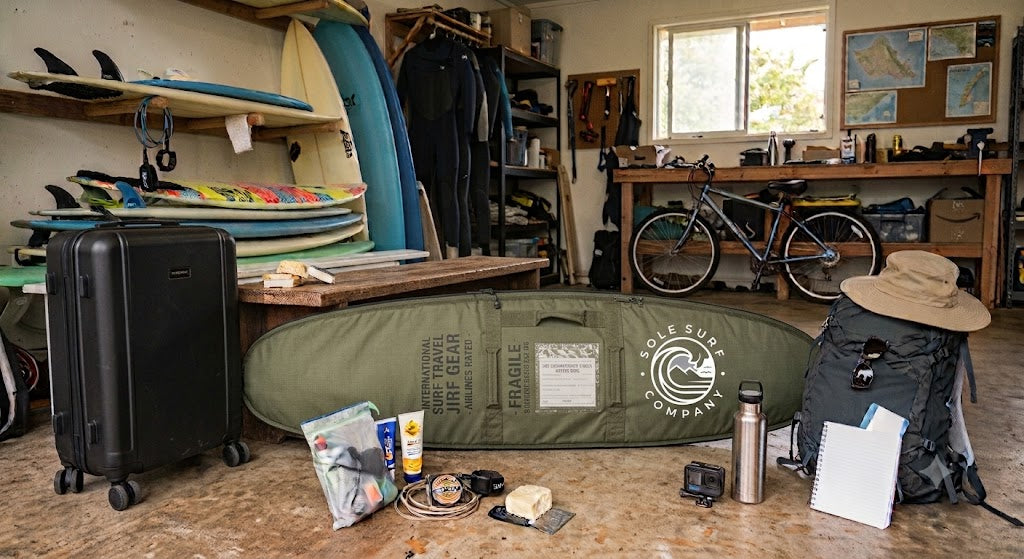
Surf Trip Packing List: The Complete Guide
1. Research the Destination Before Packing
Before pulling boards out of the rack, find out what you are actually preparing for.
- Expected swell direction, wave size and wind pattern
- Reef, point, beach-break or mixed-wave setup
- Water and air temperatures
- Rainy, cyclone or monsoon season
- Whether reef booties or a surf helmet are recommended
- Distance to the nearest surf shop and board-repair service
- Availability and quality of rental boards
- Medical facilities and realistic evacuation route
- Local transportation and board-bag capacity
- Boat baggage and storage limitations
- Electrical outlets and cellular coverage
- Local laws, customs and health recommendations
Check Every Part of the Transportation Chain
Review the airline's current surfboard policy before buying a ticket. Confirm the maximum bag length and weight, the number of boards permitted, whether advance registration is required and whether the fee is charged per bag or per board.
Do not stop at the airline. Confirm that airport transfers, taxis, rental cars and boats can carry the length and number of boards you plan to bring. A board bag that makes it through the airport can still become a problem at the dock.
2. Documents, Money and Emergency Information
Passport rules vary by country. Some destinations require six months of remaining validity, while others do not. Check the official requirements for every country on your itinerary, including transit stops. The U.S. Department of State recommends confirming destination-specific requirements before travel.
- Passport with sufficient validity and blank pages
- Visa or electronic travel authorization
- Driver's license and International Driving Permit, if required
- Airline, lodging and transfer confirmations
- Travel-insurance policy and emergency number
- Copies of prescriptions and a copy of your passport’s information page
- Emergency contacts
- Primary payment card
- Backup card stored separately
- Local currency and small bills
- Digital and printed copies of important documents
- Offline itinerary and accommodation address
- Waterproof document pouch
Leave your itinerary, insurance details and emergency contacts with someone at home.
3. Travel Insurance for Surf Trips
Do not assume that a general travel policy covers surfing. Some policies exclude it, restrict certain activities or apply equipment limits that are far below the value of a board bag.
For a remote island or charter trip, emergency medical evacuation coverage is essential. A serious injury may require a boat transfer and an aircraft before you reach a hospital capable of treating it. Some remote operators require proof of coverage before arrival.
Insurance Checklist
- Surfing is explicitly covered
- Emergency medical treatment is covered
- Evacuation from a remote island, boat or surf break is covered
- Medical transportation or repatriation home is covered
- Trip cancellation and interruption are covered
- Missed connections and baggage delays are covered
- Surfboard loss, theft and damage are addressed
- Equipment sub-limits are high enough for your gear
- Scooter or motorcycle use is covered, if applicable
- License and helmet requirements are understood
- A 24-hour assistance number is provided
Read the exclusions—not just the sales summary—and ask the insurer to clarify anything uncertain in writing.
4. Choosing Your Boards
For most trips where you bring your own equipment, two or three boards provide a practical balance between options and baggage weight.
| Board | Purpose |
| Primary board | The board you trust in the conditions expected most often |
| Backup board | A familiar alternative if the primary board is damaged |
| Optional third board | Either a step-up for larger surf or a small-wave board—choose according to the destination |
More boards are not automatically better. Every additional board adds weight, fees and another piece of equipment that can be damaged. A guided camp with good rentals may require no personal boards at all.
5. Protecting Your Boards
A padded travel bag is only the first layer. Remove the fins, protect the nose and tail, cover the rails and keep stacked boards from rubbing against one another.
Reusable protection is better than padding that gets destroyed on the first flight. Lightweight closed-cell foam rail guards, padded board sleeves and a compact foam layer across the deck and bottom can be stored inside the board bag and used again for the return trip.
Board-Bag Checklist
- Properly padded travel board bag
- Individual board socks or sleeves
- Fins removed before flying
- Reusable rail guards
- Nose and tail protection
- Padding between boards
- Deck and bottom protection without hard pressure points
- Empty spaces filled with soft clothing or towels
- External luggage tag
- Contact information placed inside the bag
- Zippers and loose straps secured
- Small luggage scale
- Baggage tracker
Photograph each board before packing and photograph the closed bag at the airport. Those pictures can help document its condition if a damage claim becomes necessary.
6. Fins, Leashes and Surf Hardware
The farther you are from a surf shop, the more backup equipment matters. For a developed surf town, one spare leash and one backup fin set may be enough. A remote trip deserves more redundancy.
- Primary fin set for every board
- At least one complete backup fin set
- Fins appropriate for the expected waves
- One spare leash for an ordinary trip
- Additional or heavier leash for remote, reef or larger surf
- Spare leash strings
- Fin key and compatible fin tool
- Spare fin or grub screws
- Wax matched to the water temperature
- Basecoat wax, if used
- Wax comb and sealed wax box
- Tie-down straps
- Portable soft racks when vehicle racks are uncertain
You generally do not need two complete fin sets for every board. Bring enough compatible backup equipment to keep at least one board surfable if something breaks.
7. Temporary Board Repair
A small repair kit can stop a crack from taking on water until a proper repair is available. Repair kits are usually available at your local surf shop, but make sure the product is compatible with your board. Kits are generally made for either PU/polyester or EPS/epoxy construction. When you are unsure, an epoxy repair kit is typically the safer choice because it can generally be used on both types of boards. Never use polyester resin on an EPS board because it can damage the foam. Pack the following items when appropriate:
- Board-compatible repair putty or resin
- Fiberglass cloth, if you know how to use it
- Sandpaper
- Waterproof ding-repair tape
- Alcohol wipes for surface preparation
- Disposable gloves
- Small applicator
- Spare vent plug, if applicable
Do not automatically pack resin in checked luggage. Many resins, solvents and adhesives are classified as flammable and may be prohibited in both checked and carry-on baggage. Check the product label, Safety Data Sheet, airline rules and FAA PackSafe guidance before flying. When uncertain, bring waterproof repair tape and buy repair products after arrival.
8. In-Water Clothing and Sun Protection
Wetsuit needs depend on water temperature, wind, session length and individual tolerance. Ask a trusted local shop or surf operator what people are actually wearing during your travel dates.
| Conditions | Typical starting point—not a universal rule |
| Warm tropical water | Boardshorts or swimsuit, rash guard and optional thin neoprene top |
| Mild water | Springsuit or 2mm top, depending on wind and tolerance |
| Cool water | 3/2mm or 4/3mm wetsuit |
| Cold water | 4/3mm or 5/4mm suit with hood, boots and gloves as needed |
Surf-Wear Checklist
- Two or three pairs of boardshorts, depending on trip length
- Long-sleeve and short-sleeve UPF rash guards
- Appropriate wetsuit
- Thin neoprene jacket or vest for windy mornings
- Reef booties
- Surf hat with a secure strap
- Surf earplugs
- Anti-chafe balm (petroleum jelly) aka vaseline
- Surf helmet when appropriate for shallow reef or heavy conditions
Sun-Protection Checklist
- Water-resistant broad-spectrum SPF 50 sunscreen
- Face zinc
- SPF lip balm
- Hat and polarized sunglasses
- Aloe vera or fragrance-free after-sun lotion
Bring enough trusted sun protection for the trip. Products may be limited or expensive in remote destinations. Follow local environmental rules and avoid treating labels such as “reef safe” as a substitute for checking the actual ingredients.
9. First Aid and Personal Health
Reef cuts and other wounds exposed to natural water can become infected. For a minor wound, stop the bleeding, rinse it thoroughly with clean running or bottled water, gently clean around it with soap, remove obvious loose debris when safe and cover it with a clean dressing. The CDC advises washing wounds exposed to untreated recreational water thoroughly with soap and water.
Do not publish or follow a universal instruction to scrub a wound with lime, hydrogen peroxide or harsh chemicals. Deep puncture wounds, heavily contaminated wounds, or wounds with embedded coral should be evaluated by a qualified medical professional. Seek care for increasing pain, spreading redness, warmth, swelling, drainage, fever or red streaking.
First-Aid Checklist
- Personal prescription medication
- Extra essential medication in the carry-on
- Prescription copies and allergy information
- Clean water or sterile wound-irrigation solution
- Mild soap
- Sterile gauze and non-stick dressings
- Waterproof medical tape and bandages
- Antiseptic product used according to its label
- Tweezers and small scissors in checked baggage
- Pain reliever suitable for you
- Antihistamine suitable for you
- Motion-sickness medication
- Anti-diarrheal medication
- Oral rehydration or electrolyte packets
- Insect repellent
- Hand sanitizer
- Blister treatment
Ask a doctor or travel clinic about vaccinations, prescription antibiotics and destination-specific medication. Do not self-prescribe antibiotics or attempt to remove deeply embedded coral or sea-urchin spines without appropriate guidance.
10. Clothing, Bags and Daily Essentials
Pack light and favor clothing that dries quickly. Heavy cotton is comfortable but dries slowly and becomes heavy in humid conditions.
- Lightweight shirts and shorts
- One long-sleeve shirt
- Light hoodie, fleece or windbreaker
- Packable rain jacket or poncho
- Sandals or slippers
- Walking shoes or light hikers
- One clean casual outfit
- Laundry bag and small amount of detergent
- Carry-on backpack
- Waterproof dry bag
- Wet bag for surf clothing
- Quick-dry towel or changing poncho
- Reusable water bottle
- Small day bag
11. Electronics and Communication
- Phone and charging cable
- International plug adapter
- Power bank
- Waterproof phone pouch
- Camera or action camera
- Spare batteries and memory cards
- Headlamp
- Local SIM or eSIM
- Offline maps and important contact information
- Satellite communicator for unsupported remote travel, when appropriate
Power banks and spare lithium batteries belong in carry-on baggage, not checked luggage. Confirm capacity limits and airline requirements before departure. TSA battery guidance
12. Remote Island and Boat Additions
When the nearest surf shop, airport or hospital is hours away, redundancy matters. Confirm what the operator already carries instead of assuming emergency equipment will be available.
- Emergency medical evacuation and repatriation coverage
- Two or three destination-appropriate boards
- Additional compatible fins and leashes
- Extra leash strings, wax and repair tape
- Extra sunscreen and reef-cut supplies
- Seasickness medication
- Headlamp with spare batteries
- Backup cash
- Water-purification method when required
- Emergency whistle
- Reliable emergency communication
- Operator has your medical information and emergency contact
- Clear explanation of the evacuation procedure
- Confirmation that the boat or camp carries oxygen and a proper trauma kit
13. Guided Surf Camp and Rental-Board Version
Many surf camps supply boards, wetsuits, leashes, wax, towels or transportation. Verify the details before leaving your equipment at home.
- Boards are available for your size, ability and expected waves
- Wetsuits are available in the correct size and thickness
- Leashes, fins and wax are included
- Equipment may be used outside scheduled lessons
- Replacement equipment is available
- Rental, damage and deposit charges are understood
- Towels, bedding and other bulky items are supplied
- Transfers can carry a board bag if you bring your own
Even when equipment is supplied, bring personal surf clothing, sunscreen, medication, documents, money, a water bottle and a compact first-aid kit.
14. Carry-On Non-Negotiables
Checked luggage gets delayed. Your carry-on should keep you functional for at least the first day.
- Passport, visa and wallet
- Phone, charger and power bank
- Personal medication and prescriptions
- Insurance details and emergency number
- Accommodation address and transfer contact
- One swimsuit or pair of boardshorts
- One rash guard
- One change of clothes
- Toothbrush and airline-compliant toiletries
- Any essential item that cannot be replaced at the destination
Fins, leashes and repair tools are not universal carry-on essentials. A rental board normally comes with compatible fins and a leash, while sharp tools and liquids may create screening problems.
15. What Not to Pack Automatically
-
Every board you own when suitable rentals are confirmed
-
A wetsuit when the camp supplies the correct size and thickness
-
Ten bars of wax for an ordinary one-week trip
-
Excessive backup gear when surf shops are nearby
-
Heavy clothing for a tropical destination
-
Full-size toiletries that can easily be purchased after arrival
-
Valuable jewelry or unnecessary electronics
-
Disposable board padding that cannot be reused for the return trip
-
Unverified resin, solvents or prohibited tools
Final Departure Checklist
One Week Before
- Reconfirm flights, transfers and accommodation
- Recheck the forecast and water temperature
- Confirm the current airline board policy
- Confirm passport and entry requirements
- Review insurance coverage and exclusions
- Refill prescriptions
- Download maps and travel documents
- Notify banks when required
Before Leaving Home
- Photograph the boards
- Remove the fins and protect the boards
- Weigh every checked bag
- Charge electronics and power banks
- Put identification inside every bag
- Give the itinerary to someone at home
- Check that passport, wallet and medication are physically in the carry-on
Pack for the Place You Are Actually Going
The best surf-trip packing list is not the longest. It is the one built around the destination, expected waves and how difficult it will be to replace something once you arrive.
A trip to a developed surf town allows you to travel light. A guided camp may supply almost everything. A remote boat trip requires stronger board protection, backup equipment, serious first-aid preparation and insurance capable of getting you to proper medical care.
Prepare for the problems that can realistically end the trip, then stop packing. You are going there to surf—not to carry everything you own halfway around the world.
Want a copy you can save or print?
Download the Printable Surf Trip Checklist (PDF)
Ready for the next trip?
Explore comfortable, island-born apparel made for early surf checks, travel days and life away from the water.
Shop Sole Surf Company Essentials
Sources Consulted
This guide combines recommendations from 20 surf-travel, camp, charter and retail sources. Some focus on independent board travel; others cover remote expeditions or camps where equipment is supplied.
-
Lush Palm — Surf Trip Packing List
-
LUEX — Packing for a Distant Surf Paradise
-
Lapoint — Things to Pack for a Surf Trip
-
Cleanline Surf — Surf Trip Essentials
-
Rise Up Surf Retreats — Essential Surf Trip Packing List
-
Surf Cascais — Surf Camp Packing List
-
Mentawai Surf Retreat — Checklist
-
World Surfaris — Surf Charter Essentials
-
Billabong — Surf Trip Packing Guide
-
Beach Break Surf Camp — Panama Packing List
-
Surfd — Preparing for a Surf Trip
-
Surfari — Tropical Surf Trip Packing List
-
Ripar Surf School — Packing Your Bags
-
Yume Surf Camps — Portugal Surf Camp Packing List
-
Kala Surf Camp — Bali Surf Holiday Packing
-
Atlantik Surf — Surf Camp Vacation Packing List
-
Mondo Surf Village — What to Bring to Bali
-
Nuna Surf — Lombok Surf Camp Packing List
-
Tiki Adventures — Charter Packing List
-
Endless Summer Surf Camp — What to Bring
Medical and aviation-safety recommendations were checked against current guidance from the CDC, U.S. Department of State, FAA and TSA.


Hinterlasse einen Kommentar
Diese Website ist durch hCaptcha geschützt und es gelten die allgemeinen Geschäftsbedingungen und Datenschutzbestimmungen von hCaptcha.