
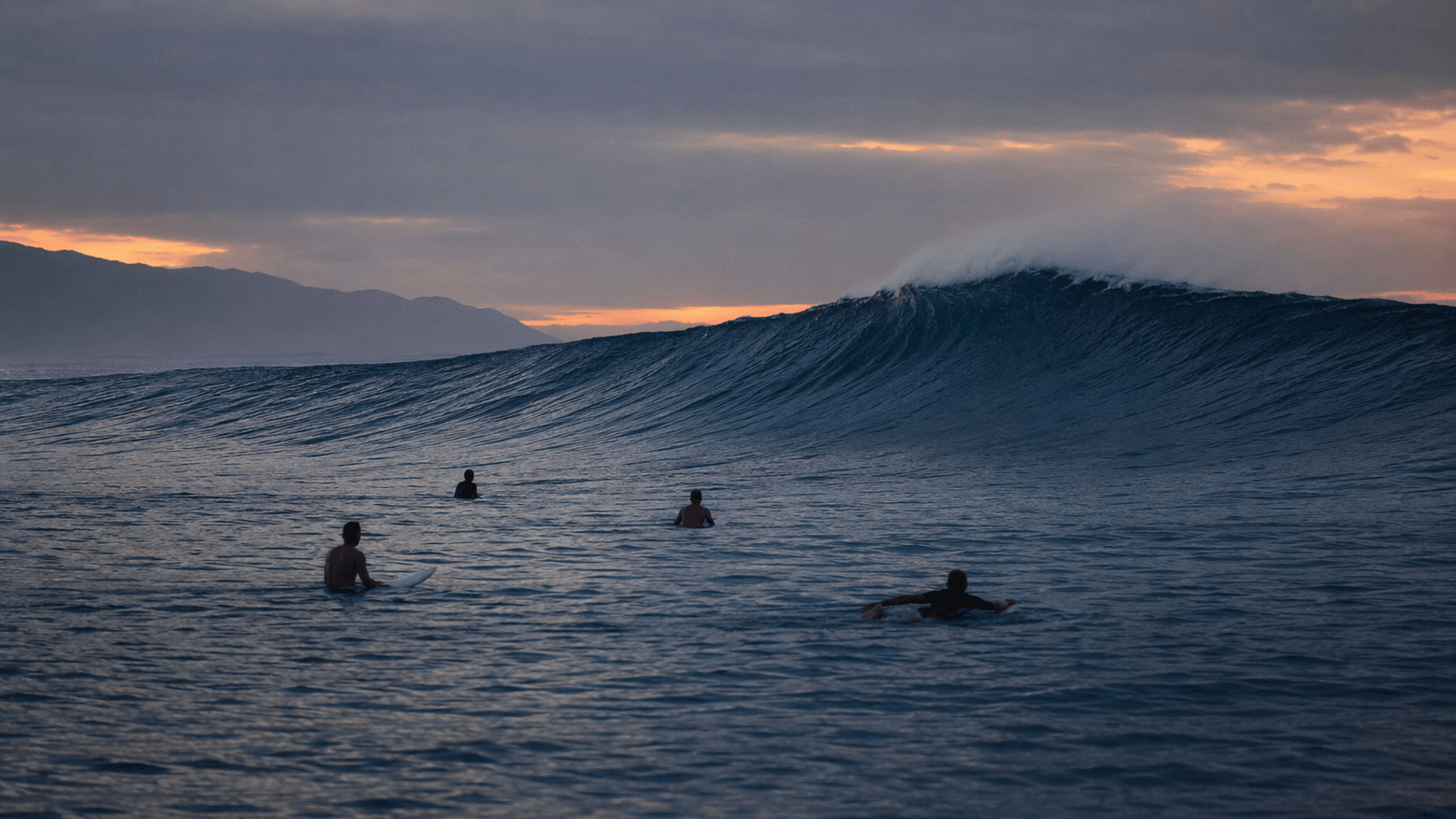
Does Anyone Own a Wave?
A thought experiment on Hawaiʻi, localism, and what it means to put in your time
Localism is easy to criticize—until you imagine a major surf break without it.
Without some form of locally understood order, a crowded lineup can collapse into dangerous chaos. Visitors paddle straight to the peak and take over. Large traveling groups dominate small breaks through sheer numbers. Media crews, commercial operators, and aggressive influencers push everyday surfers aside. At a heavy wave like Pipeline, disorder is not only frustrating; it can become a direct threat to human life.
Spend enough time at one break and you begin to know it intimately. You learn where to sit, which swells make it work, how the currents shift, and which waves look beautiful but close out. You recognize the people who are there year after year. You see who helps when someone is in trouble, who protects public access, who cleans the beach, and who only appears when the forecast turns purple.
When no one feels responsible for a wave, everyone consumes it, but no one protects it.
Eliminating localism entirely is not the answer. Order and stewardship are necessary. The harder question is what that order should look like and what limits should be placed on those who enforce it.
Ultimately, this is not just a debate about surf etiquette. It is a question about fairness.
The Historical Roots of Lineup Order
The history of Oʻahu’s North Shore shows why localism cannot be dismissed as simple aggression. Modern organized localism in Hawaiʻi was sharpened, at least in part, by cultural displacement and conflict with visiting surfers.
During the mid-1970s, a group of ambitious Australian and South African surfers arrived in Hawaiʻi determined to establish themselves in the emerging world of professional surfing. Their high-performance approach helped push the sport forward, but their presence and outspoken confidence also created deep conflict with local and Native Hawaiian surfers who felt disrespected in their own home.
This era—later documented in Bustin’ Down the Door—represented two very different realities.
- To the visiting surfers, it was a story of challenging an established order and helping build professional surfing.
- To many Hawaiians, it looked like outsiders arriving, claiming Hawaiʻi’s best waves, dismissing Hawaiian surfers, and building careers from a cultural practice Hawaiʻi had shared with the world.
In 1975, a group of North Shore watermen formed Hui O Heʻe Nalu, translated by the organization as the Club of Wave Sliders and later widely known as Da Hui or the Black Shorts. The organization describes its founding as a response to foreign defiance and claims over Native Hawaiian surfing, with the goal of protecting Native Hawaiian rights on land and in the ocean. Its members became known for reasserting local authority through firm—and at times violent—enforcement.
Decades later, in the early 2000s, another group known as the Wolfpak arose at Pipeline. Its members imposed a strict hierarchy on a lineup they believed had become dangerously disorderly. Their heavy-handed methods drew widespread controversy, but the underlying problem they described was real: Pipeline had become intensely crowded, and reckless behavior at an already life-threatening wave increased the danger for everyone.
These groups arose in different periods and under different circumstances, but both illustrate the central defense of localism. When a local community does nothing, outside interests with greater numbers, money, media influence, or aggression can move in. A community can lose authority over its home break without a single legal title ever being signed.
But that defense immediately leads to a harder question: When does protection become possession?
The Hawaiian Paradox and the Meaning of “Local”
Surfing—heʻe nalu—was practiced across Polynesia, but Native Hawaiians developed it into a central cultural, social, and spiritual practice. Hawaiʻi also became the source of much of what the world now recognizes as modern surfing. Exhibitions centered on Kānaka Maoli perspectives describe surfing as an Indigenous Hawaiian legacy that has often been separated from its cultural origins by the modern surf industry.
Now consider a thought experiment.
Imagine Native Hawaiians traveling to surf breaks in California, Australia, Indonesia, Portugal, or Japan, paddling directly to the deepest peak, and claiming automatic priority because their ancestors shaped the practice that became modern surfing.
Most surfers would reject that claim. They might respect surfing’s Hawaiian roots, but they would argue that localism is tied to a specific place and community. A surfer in California could reasonably say that Hawaiian cultural ancestry does not determine priority on a California reef whose crowds, access, and safety are managed by the people who live there.
That seems fair. It also clarifies the issue.
A deep relationship with one break may justify recognition, responsibility, and a meaningful voice in how that place is cared for. But should that relationship ever become permanent priority over everyone else?
If cultural origin alone does not create ownership, can years of local experience create something more than recognition, responsibility, and standing within the community?
Native Hawaiian ancestry does not automatically move someone to the front of the lineup, even at Hawaiʻi’s most famous breaks. Position is more often determined by ability, reputation, relationships, confidence, and acceptance by the group already controlling the peak.
So what actually makes someone local?
Is it Native Hawaiian ancestry? Being born in Hawaiʻi? Growing up near a particular break? Living there for twenty years? Contributing to the community? Being accepted by the established surfers? Or simply having enough ability, influence, and friends to enforce a position?
Consider a surfer born and raised beside one of Hawaiʻi’s most famous waves to parents who moved to the islands from somewhere else. That surfer grows up in the community, learns the break from childhood, masters the wave, and earns widespread respect.
Few people would argue that the surfer does not belong. A lifelong relationship with a wave and its community is real, regardless of where that person’s parents were born.
But does belonging create ownership? When does one family’s arrival become local authority? Does being born beside a wave create a stronger claim than ancestral connection? Does exceptional talent matter more than history?
Belonging to a coastal community is real and valuable. But belonging is not the same as possessing the water moving through it.
What Does “Putting In Your Time” Really Earn?
The most common phrase used to justify priority in the water is simple:
“I put in my time here.”
There is real truth behind that claim. Time spent at a break builds knowledge, skill, ocean sense, and safety awareness. Those qualities matter when conditions become heavy. Someone who has surfed a wave regularly for twenty years may understand its currents, cleanup sets, shifting takeoff zones, and consequences in a way a visitor cannot. That experience deserves respect, especially when safety is involved.
But what, exactly, does that experience earn on an ordinary day?
Does two decades of attendance entitle someone to every set wave? Does it create permanent priority over a surfer who has been waiting patiently for an hour? At what point has the ocean repaid its debt? Who made that agreement in the first place?
If years logged in the water created absolute authority, the oldest and longest-serving surfers would always receive the best waves. In reality, priority frequently goes to the most aggressive surfers or those backed by the strongest group. “Putting in your time” can become a principle invoked only when it benefits the person saying it.
Time at a break creates knowledge, familiarity, relationships, and belonging. It should earn recognition. But recognition is not necessarily ownership.
Perhaps time should be measured partly by contribution:
- Did you defend public access and help keep the beach clean?
- Did you help surfers and swimmers in trouble?
- Did you mentor younger surfers and respect the surrounding neighborhood?
- Did you leave the place better than you found it?
Or did you simply take waves there for a very long time?
When Governance Becomes Monopoly
Few surfers explicitly claim to own a wave in the legal sense. Instead, they claim some authority to govern the lineup.
At difficult and crowded breaks, a degree of informal governance can serve a legitimate purpose. It can maintain safety, discourage reckless behavior, protect access, and prevent a visiting group or commercial interest from overwhelming the community.
The breakdown occurs when necessary governance becomes personal monopoly.
- Healthy localism asks: “How do we care for this place?”
- Unhealthy localism asks: “How do we keep this place for ourselves?”
From the beach, those attitudes can look almost identical. In the water, they produce very different results.
When stewardship turns into possession, maintaining safety becomes an excuse for deciding who is worthy of surfing. Preserving culture becomes a justification for personal entitlement, back-paddling, intimidation, and permanent priority for one group. Protecting the break quietly becomes protecting the locals’ wave count.
Respect must work in both directions. A visitor should not enter a new lineup with arrogant entitlement. Visitors should observe the rotation, wait their turn, understand their limits, and respect the culture and community surrounding the break. Buying a plane ticket does not provide the knowledge built through years at a wave, and public access is not permission to behave without awareness.
At the same time, a local surfer’s history does not excuse greed, threats, or taking every set. Being local should carry greater responsibility to care for the break—not unlimited privilege to monopolize it.
Fairness also changes with the wave. At a heavy and dangerous break, skill, judgment, experience, and established order should carry greater weight because mistakes can injure or kill someone. At an ordinary or beginner-friendly break, patience, basic priority rules, and turn-taking should matter more than hierarchy.
Fairness recognizes experience, contribution, cultural connection, and safety without allowing any of them to become an unlimited claim over the ocean.
A fair system should protect the environment, honor Native Hawaiian culture, recognize genuine experience, maintain safety, and still leave room for a respectful visitor to participate.
That balance is difficult. It may also be the only form of localism worth defending.
Does Anyone Own a Wave?
Without local responsibility, chaotic crowds and commercial interests can overwhelm a fragile break. History shows why local communities sometimes need to stand together and protect what could otherwise be taken from them.
But governance is not possession.
The moment localism becomes an absolute claim over the peak, it begins repeating the very behavior it was created to resist: one group using power to push everyone else aside.
No surfer built the reef. No local generated the swell, directed the wind, or purchased the water moving toward shore. Surfing a place for decades creates a deep relationship with it—not a title deed.
Maybe we are all temporary participants in something that existed long before us and will continue long after we are gone.
The question may not be, “Who owns this wave?” or even, “Who deserves it most?”
Maybe it is simply: “Who is treating this place—and the people sharing it—with the most respect?”
The ocean does not know where we were born, how long we have lived nearby, or how many years we believe we have put in. A wave rises, breaks, and disappears.
Then another one comes.
Daniel Sole
Founder, Sole Surf Company
Image Note: The featured image was generated using AI.

コメントを書く
このサイトはhCaptchaによって保護されており、hCaptchaプライバシーポリシーおよび利用規約が適用されます。