
I had major Knee Surgery. I Should Have Paddled In.
It was sometime in November a few years back when I left my house around 5:15 in the morning. I reached the surf spot around 6:15 and was in the water about half an hour later, just as the day began.
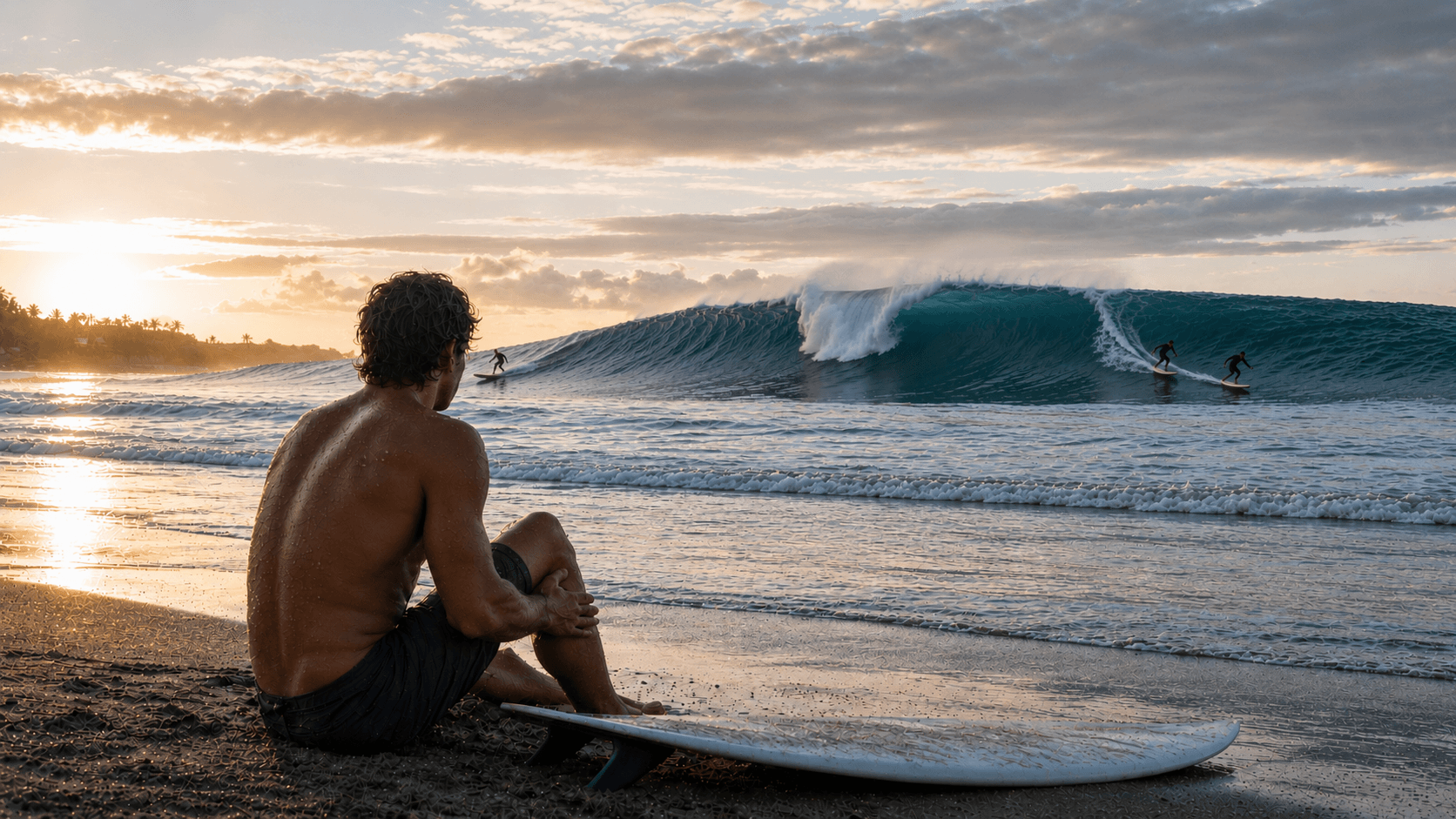
The conditions were incredible: glassy, solid six-to-eight-foot Hawaiian surf with only three or four people in the lineup. Huge barrels rolled through, some of them wide enough to drive a car through.
I spent the first hour catching waves and having fun. The lineup worked exactly as a good lineup should. No one was back-paddling or snaking anyone. We gave each other space, took turns and made sure everyone got waves. The surf had real consequence, but the mood in the water was relaxed.
It was one of those mornings that made the early wake-up completely worth it.
I had already scored.
As the morning went on, the lineup grew to about six surfers. Eventually, a set came through and everyone caught a wave except me. Once it cleared, I was sitting out the back near the peak, waiting for the next set.
That was when two professional surfers paddled out. They came straight to the peak and paddled past me.
I’m not going to name either of them because this story isn’t about publicly attacking anyone. It is about what happened in the lineup, how I responded and what that response ultimately cost me.
When the next set arrived, one of them began paddling beside me. He angled to the right while I angled to the left. I caught the wave, got to my feet and started riding.
Almost immediately, the other professional dropped in about three feet ahead of me.
He saw me. There was no realistic possibility that he didn’t. I was already standing and riding directly behind him, close enough that I could have reached out and pushed him.
Instead, I kicked out to avoid a collision.
At first, I wasn’t going to say anything. Drop-ins happen, even though they shouldn’t. Sometimes someone genuinely doesn’t see you. Sometimes there is confusion in the lineup. Sometimes it is better to let one wave go and continue enjoying the session.
What happened afterward bothered me more than the drop-in itself.
He began talking to his friend loudly enough for me to hear. He said I shouldn’t have paddled for the wave because I wasn’t going to make it.
That explanation made no sense. I had already made the drop and was riding directly behind him before I kicked out.
Eventually, I said, “You dropped in on me.”
He gave me a dismissive look, as if I had no right to question him.
“Hey, I’m just out here surfing,” I said.
“So am I,” he answered. Then he added, “Let’s see who’s the better surfer.”
There was never any question about who was better. He was a professional surfer, and I was a regular guy trying to enjoy a good morning. Of course he was better than me.
But that wasn’t the point.
There is something to be said for better surfers getting better waves. They read the ocean better, position themselves more accurately, paddle harder and make drops the average surfer cannot. That is part of surfing, and I understand it. A more skilled surfer will naturally find more opportunities than someone with less experience.
But being the better surfer does not mean every wave belongs to you.
Surf etiquette cannot disappear whenever a more talented surfer enters the water. If ability alone determined priority, professionals could paddle around everyone and take every wave they wanted. The rest of us would become nothing more than obstacles in their way.
In this case, I had waited while everyone else caught a wave. I was sitting near the peak when the two professionals paddled past me. I caught the next wave, and one of them knowingly dropped in.
He was wrong.
What I did next, however, was still my responsibility.
The Moment I Should Have Paddled In
That exchange should have been the end of my session.
I had already spent more than an hour surfing glassy, six-to-eight-foot Hawaiian waves with only a handful of people out. I had caught good waves beneath enormous barrels. It had been a great morning.
I should have recognized that, paddled in and gone home grateful.
Instead, I let my pride take over.
I wanted to show him that I wasn’t intimidated. I wanted to prove that I belonged in the lineup and wasn’t going to be pushed around. In that moment, paddling in felt like backing down and letting him win.
I became overly focused on catching another wave to prove that I wasn’t going anywhere. I was so annoyed that I stopped thinking clearly.
Eventually, I paddled for a very steep wave. I was behind it and knew I was too late. I shouldn’t have gone, but I committed anyway.
I made the drop and reached the bottom, but my positioning was wrong. The wave came down and crushed my knee.
I tore my PCL, MCL and meniscus. The injuries required major knee surgery and kept me out of work for months.
It would be easy to blame the entire injury on what happened with the professional surfer, but that wouldn’t be honest. His behavior affected me, but he didn’t make me stay in the water. He didn’t make me take that wave.
Those decisions were mine. I made them after allowing anger and pride to take control of my judgment.
He dropped in on one wave.
My ego did the rest.
Being Right Isn’t Enough
My knee is now a constant reminder of what a few moments of ego can do.
I’m not saying you should never stand up for yourself. There are times when something needs to be said, especially when another surfer’s actions put you in danger. I don’t regret calmly telling him that he dropped in on me.
Standing up for yourself and losing focus in waves of real consequence are not the same thing.
Even when you are right—even when someone has clearly disrespected you—you still have to remain calm and make good decisions.
That professional surfer probably forgot about our exchange before the day was over. To him, it was one wave and a few words in the lineup. He has no idea what happened afterward, and even if he did, it probably wouldn’t affect him very much.
I will live with what happened next for years.
My knee will never be exactly what it was before that morning. Every ache is a reminder that I allowed someone else’s actions to determine mine.
He was wrong to back-paddle me, wrong to drop in and wrong to talk down to me afterward. None of that required me to spend the rest of the session trying to prove something. I could have acknowledged that he was wrong without allowing his behavior to dictate what I did next.
I read a book a few years ago by Ryan Holiday titled Ego Is the Enemy. I understand those words differently now.
Ego does not always announce itself as arrogance. Sometimes it sounds completely reasonable. It tells you that you cannot let someone else win, that you need to prove you belong or that walking away will make you look weak.
That morning, I listened.
The sad part is that I didn’t prove anything to him. He went on with his life and probably never thought about me again.
I was the one who carried the consequences home.
I had already enjoyed the kind of morning surfers wake up before dawn hoping to find. I had caught good waves in beautiful conditions with almost no one around, but I allowed one person, one wave and one exchange to erase all of it.
I had already scored.
I should have paddled in.
Walking away isn’t always weakness. Sometimes it is the strongest—and smartest—decision you can make.
Daniel Sole
Founder, Sole Surf Company
Image Note: The featured image was generated using AI.


Leave a comment
This site is protected by hCaptcha and the hCaptcha Privacy Policy and Terms of Service apply.